The easiest scavenger hunt for kids is a list of six to eight things they can point to in one space. Give each pair a pencil, set a clear boundary, and ask them to find five things before coming back. If you want a story or a surprise at the end, use a trail of clues instead. This guide helps you choose between the two and gives you a game you can start with a blank sheet of paper.
Choose the kind of hunt that fits your group
A hunt can be a quiet activity for two children or a shared game for a group. What changes is the work the adult does first. A checklist asks players to find examples in any order. A clue trail sends them to specific places in a sequence, so the host places each card in advance. A matching hunt gives them a target such as a shape, pattern, or pair of objects. Start with the first option if you have a short window or have not seen the room before.
| Format | Best when | Estimated play |
|---|---|---|
| Find and point | Ages 6–8 or mixed readers; the space has everyday objects in view | 10–15 minutes |
| Match or compare | Ages 7–10; players like explaining how two finds are alike | 10–20 minutes |
| Clue trail | Ages 7–10 with a reader available; you can place cards beforehand | 15–25 minutes |
Times are starting estimates. Let players finish the find they are on when time is up.
Try this eight-item hunt with paper and a pencil
Suggested ages: 6–10. Estimated time: 3–5 minutes to check the space and 10–15 minutes to play. Copy the list or read it out loud. The job is to find any five items and show or name each one. Before play, walk through the allowed area and swap any prompt that has no visible example.
- Something round, like a coaster.
- Two things with the same color, like a cup and a marker.
- Something with a stripe, like a pillowcase.
- A picture of a plant, like an illustration in a book.
- Something with a handle, like a tote on a chair.
- A letter from your name, like an A on a book cover.
- Something with four corners, like a sheet of paper.
- Something soft you can point to, like a cushion.
Accept any answer that fits. A player who finds a striped sock and a striped rug can use either one. If players are sharing a list, ask them to show a partner before checking an item off.
Show players where to look and what they can touch
Give a quick tour of the play area and say the rule in one sentence: “Stay in these two rooms and point to your finds.” Pointing lets children use a book on a shelf or a picture across the room without moving anything. Agree on where they return when the list is done. If a room or piece of furniture is out of bounds, name it before play rather than correcting a child halfway through.
For a collecting game, place your own lightweight props in view and ask for only those props back. A marker cap next to someone's work or a favorite toy is easy to mistake for part of the game. Paper circles labeled with a star make better collection items. Skip drawers, stairs, high shelves, and the kitchen work area. When playing outside, use a bounded yard or a section of a park where an adult can stay with the group. Let players point to plants and leave them where they are.
Adapt the same hunt for readers and nonreaders
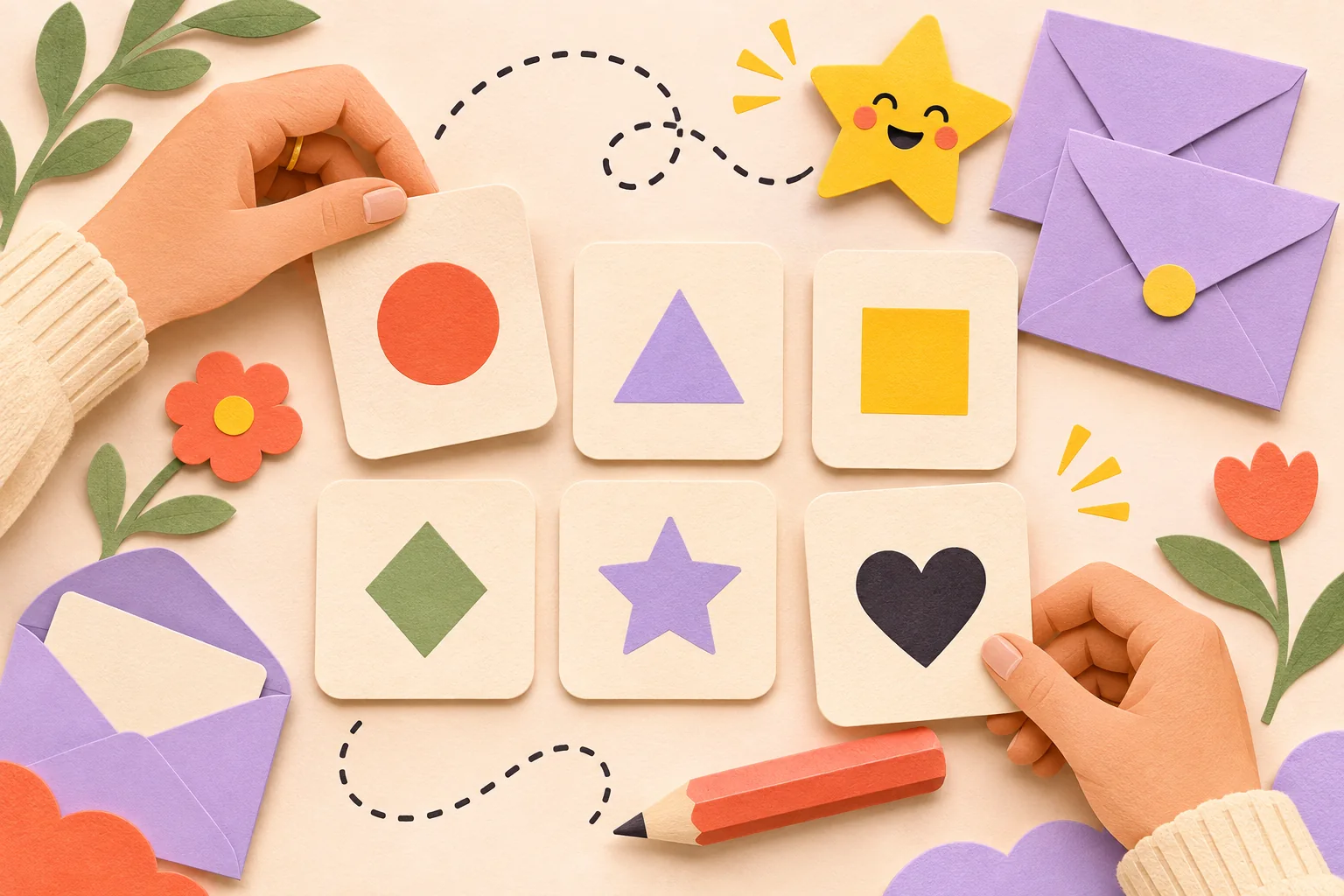
For newer readers, use one concrete word and draw a simple icon next to it. A circle stands for “round” and three parallel lines stand for “stripes.” Read the prompt once, then let the player use the picture as a reminder. Offer a nearby option for players who want to stay seated. They can point, name a match, or direct a partner.
For players ready for more, ask them to justify a match: “Show me two objects that have a pattern but use different shapes.” A striped pillow and a tile with repeating squares are valid if the child can explain what repeats. Or ask them to write one new item for the next pair. Try a pair of roles such as finder and recorder, then switch after three items. The children have different jobs and both can contribute, even if one reads faster.
Make the hunt work for siblings and groups
With siblings, try a shared target such as eight finds in all. Each child adds a find to the same list, and both can suggest a substitute when one item is hard to spot. For four to eight children, pair up and start pairs on different lines of the checklist. The last line loops back to the first. That spreads people around without giving faster readers a large head start. If you only have one pencil, let each pair say its finds to the adult or hold up fingers to keep count.
At the end, have each pair show one unexpected find. If you want a prize, offer a shared finish such as choosing the next game. There is no need to judge which object is prettiest or which group is fastest. A child who takes longer to scan the room can still make a good discovery.
Run this five-point check before you start
- Choose one area and a place to return when the hunt ends.
- Walk through once to confirm at least five prompts have easy, visible answers.
- Say whether players should point, name, or collect. Put any collection items out yourself.
- Give each pair a role and read the rules aloud. Offer a seated option when useful.
- Set a rough end time and decide what the group will share at the end.
For a rainy day, use the indoor scavenger hunt guide to plan a short route or a table game. If your group wants a story with a final surprise, the clue-writing guide shows exactly which card goes in each spot. Print the rules or keep them on your own page so players can stay focused on the room.
When you want a game you can take outside, try Backyard Color Quest. Read the adult page first and choose the play area before handing out the player sheet.
Quick questions
How many items should a kids’ scavenger hunt have?
Start with six to eight prompts and make the target five finds. For a short game or younger players, use four to six prompts and offer a skip.
Does a scavenger hunt need a prize?
A shared finish works well. Ask each pair to show a favorite find, choose the next story, or take a turn making a list for the adults.
What is the difference between a scavenger hunt and a treasure hunt?
A checklist scavenger hunt lets players find items in any order. A treasure hunt often follows clues in sequence to a final spot. Families use both names for either format, so explain the rules before you begin.
Can kids play without a phone?
Yes. Use a printed list, a handwritten sheet, or prompts read aloud. Players can point to an object and check it off instead of taking a picture.
Ready for the fun part?
Make a clue trail that fits your home, or pick a free printable adventure.
Make a treasure hunt