A printable escape room is a story told through puzzles. Print or copy a few cards, have players solve them in order, and let the adult check the final code against an answer key. An envelope can hold the ending, so you can keep the whole game at the table. The mini-game below includes three puzzles, hints, and a code you can verify before anyone plays.
Choose how the puzzles will be delivered
Decide how players should receive each puzzle. With younger children, the adult can hand out cards as the group solves them. For independent readers, numbered envelopes give the group a clear path and let the adult offer hints. A station game gives each pair its own puzzle before everyone puts the answers together. These formats work with a pencil and paper. Leave doors unlocked, and tell children the goal is to finish the story.
| Format | Best for | Estimated play |
|---|---|---|
| Adult hands out cards | One group, ages 6–8 or mixed readers | 10–20 minutes |
| Numbered envelopes | One group, ages 8–10 with a nearby adult | 15–25 minutes |
| Separate puzzle stations | Two or three pairs who can pool their answers | 20–30 minutes |
Choose a format your group can follow without repeated instructions. Add a timer only if players like it. An adult can also announce that the next puzzle is ready.
Try a three-puzzle escape room now
Suggested ages: 6–10, with an adult reader as needed. Estimated time: 5 minutes to copy the cards, 8–12 minutes to play. Write or print the three puzzle prompts below on separate cards. Put the closing message in an envelope or fold it underneath a spare sheet. Read the story: “The clubhouse captain left a message for the team. Find the three numbers that open the message.”
- Card 1: Count the triangles. Write this row: triangle, circle, triangle, square, triangle. You can draw the shapes as well as writing their names. The number of triangles is your first digit.
- Card 2: Find the middle letter. Write CAT, followed by this key: A = 1, C = 2, T = 4. Circle the middle letter in CAT. Its number is your second digit.
- Card 3: Finish the math. The captain set out eight paper flags. Two were taken down. How many flags are still up? This is your third digit.
Ask players to write the digits in card order and read the code to the adult. The envelope contains the closing message: “You found the code. The clubhouse is ready for the team!”
Keep the answer key and hints with the adult
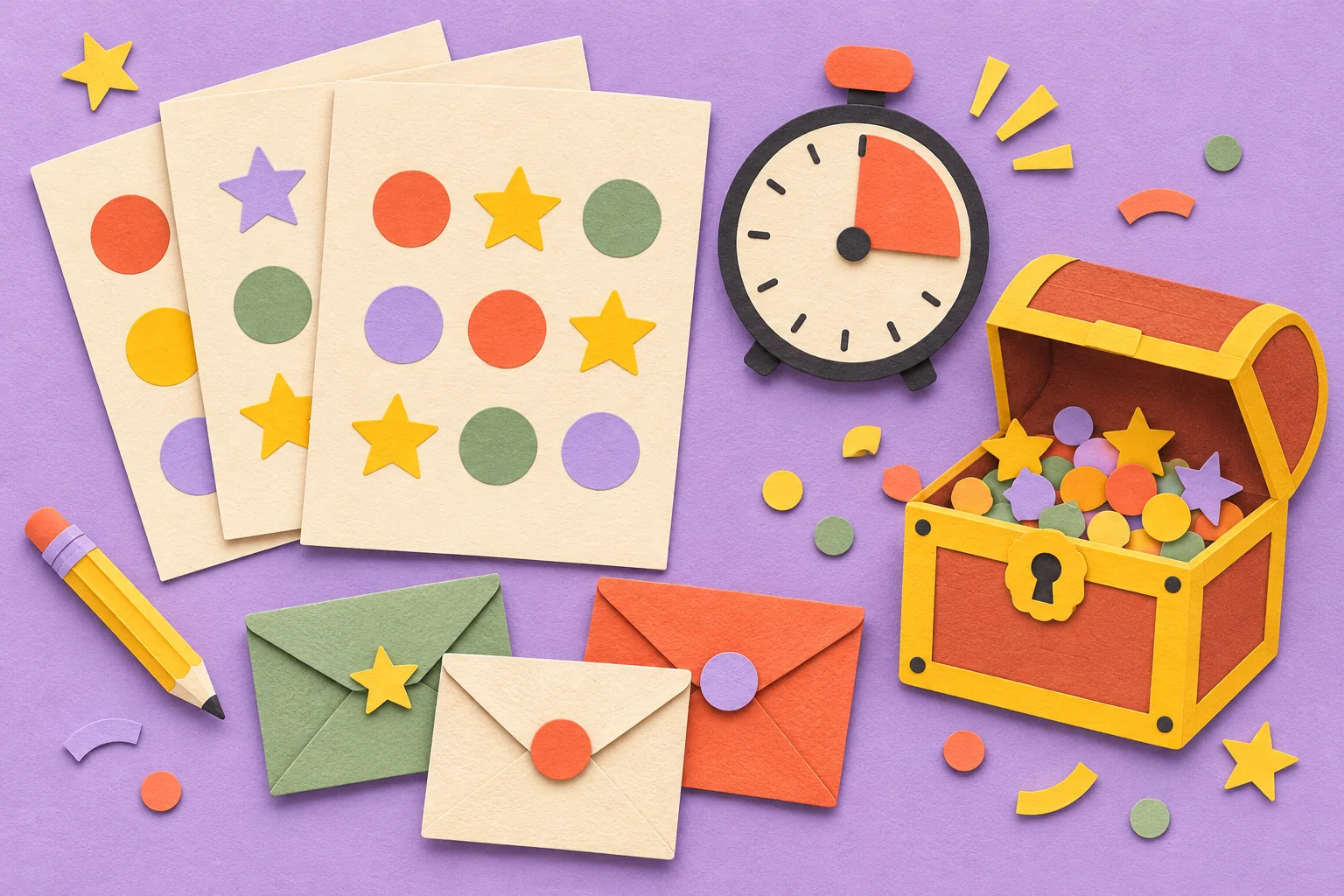
The code is 316. Card 1 has three triangles. Card 2 gives A, which equals one. Card 3 gives six because eight minus two equals six. Write the answer on the adult page. To preserve the surprise, keep this section away from the player cards.
- Card 1 hint: “Touch each triangle once as you count. Pass over the circle and square.”
- Card 2 hint: “Put a finger on the first letter and one on the last. Which letter is between them? Now look at the key.”
- Card 3 hint: “Draw eight dots and cross out two. Count the dots left.”
Offer one hint when the group wants it. Give children time to try it before you add another. If the right digits are in the wrong order, point to the card numbers. For players who want a physical check, provide three blank boxes labeled 1, 2, and 3. Accept a spoken answer, a written code, or three number cards in order.
Keep a separate place for each answer. If players write 3, 1, and 6 as they solve, the number labels tell them to read 316 even if they solved the last card first. For a story with letters instead of digits, say whether the final answer should be a word or a series of letters before play.
Lengthen a game by adding a choice, not extra steps
To expand this game for older players, replace Card 3 with a short deduction: “There are three flags, one red, one blue, and one green. Red has an 8, blue has a 6, and green has a 2. The captain's flag is neither red nor green. Write the number on the captain's flag.” The answer is still six. Print color names next to the flags so the puzzle works in black and white.
To lengthen the game for a group, give each pair a different card and a piece of paper for the answer. Ask them to explain their result to the others, then arrange the digits by card number. Puzzle-solving can happen in parallel, so one reader doesn't have to do everything. For a seated player, pass the cards around the table. If you add stations, put them on reachable tables with clear paths between them. Keep furniture, drawers, and doors out of the search area.
Print just the player pages and prepare a backup
Look at the page labels before printing. Keep the instructions and answer key with the adult. Give players the story card, the puzzles, and a place to write the code. Check that the text is readable on your printer. Color labels and simple shapes make it easier to use black ink. If your table is small, hand out one puzzle at a time.
Put the ending in a plain envelope and label it “Open after the code.” You can also fold the page if you don't have envelopes. Have one pencil and one extra sheet nearby. A helpful backup is a copy of the answers and the original puzzle prompts, in case a card is missing or a pencil mark makes something hard to read. The adult can read any page aloud.
Do an adult run-through before play
- Read the story and write down what players are trying to find.
- Solve each player puzzle without relying on the answer key.
- Confirm that the digits fit the expected order and the ending is ready.
- Keep the hints separate and make sure players can reach every card.
- Read the first card aloud and explain what to do when someone wants a hint.
For another game, see The Missing Confetti or browse ClueConfetti games. If the group would rather move between clues, use the clue trail guide to set up a route.
Quick questions
Do I need a lock or a locked room?
A paper code and an envelope are enough. The adult can check the code, then hand over or open the final message. Keep doors unlocked.
Can kids play a printable escape room without a screen?
Yes. The adult can read the story and check answers from paper. A timer is optional.
What if a group solves the puzzles out of order?
For independent puzzles, accept the answers in any order, then use the card numbers to assemble the code. For a chain, ask the adult to hand out the cards one at a time.
How long should a paper escape room be?
Start with three puzzles and a 10–20 minute window. Add one puzzle or a group discussion for players who want a longer round.
Ready for the fun part?
Make a clue trail that fits your home, or pick a free printable adventure.
Make a treasure hunt