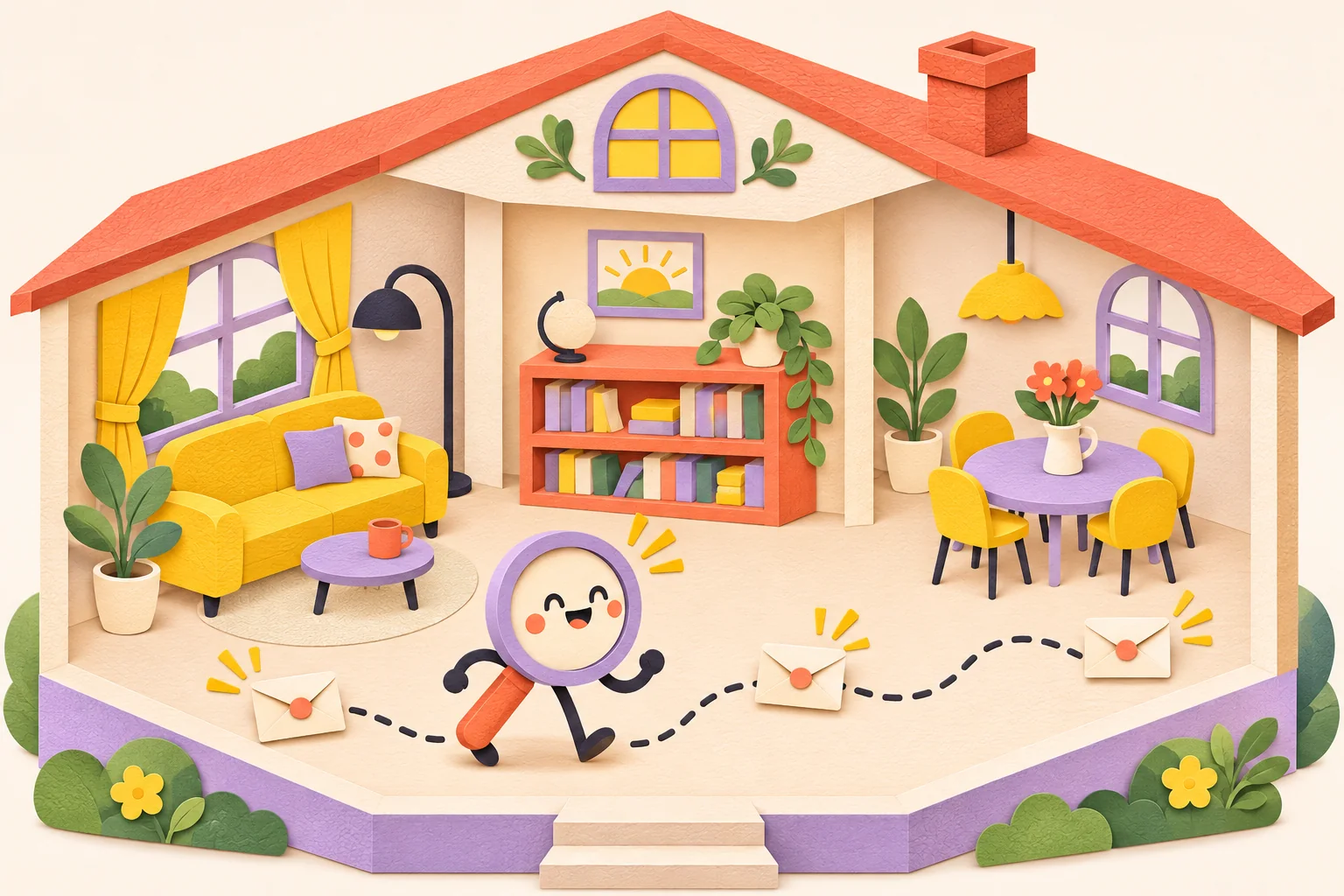
An indoor scavenger hunt can fit in one room. Choose six things already in view, ask players to find four, and let them point or name each answer. In a small apartment or a busy house, a seated hunt with objects on a tray works too. Below are a living-room game you can use right away and two ways to change the layout without moving the whole house around.
Pick the layout before you pick the clues
Decide where everyone can comfortably play. A living room with a rug, a table, and a few visible books has enough variety for a short hunt. Let players stay seated or walk around within the room. You only need a route if it makes the game more interesting. One adult can run a single room from the same place the whole time.
| Layout | Setup | Estimated play |
|---|---|---|
| One-room search | Choose six visible matches and give everyone one list | 8–12 minutes |
| Two-room stations | Put a short prompt sheet in each allowed room | 12–18 minutes |
| Table or tray hunt | Set out six to eight everyday objects within reach | 5–10 minutes |
These layouts suit ages 6–10 as starting points. For a room with several adults or younger siblings present, give the players one corner and a smaller list. A quiet hunt is still a hunt.
Before choosing a station layout, check how people already use the space. If someone needs the hallway or table during the game, bring the prompts to the players instead. An adult can put two colored sheets at opposite ends of one table and call them stations. Label them A and B so the color is optional.
Run this six-prompt living-room hunt
Suggested ages: 6–10. Estimated time: 3–5 minutes to set up, 8–12 to play. Before reading the list, put a book, a pencil, a paper square, and a folded clean cloth on a reachable table if the room is sparse. Players find four of the six answers by pointing or naming. More than one object can fit a prompt.
- Find something with printed words. A book cover works.
- Find something shorter than your hand. A short pencil works; hold a hand beside it if convenient.
- Find a shape that has four equal sides. Use the paper square as the example.
- Find something that can fold. A clean cloth or spare paper works.
- Find a blue object or something with a blue part. Check you have an example before play or swap in another color.
- Find two objects with different textures. A smooth book cover and a woven cloth work.
Finish with a simple choice: everyone picks one object to describe without naming it, and the others guess.
Turn a second room into a station
Use two stations when children want a little movement. Choose neighboring rooms on the same floor and set a prompt sheet on an open surface in each. For example, Station A in the living room asks for two things with the same color and an object made of paper. Station B at the dining table asks players to match two of the provided paper shapes. Cut or draw a square, a circle, and a second square. The matching answer is the pair of squares.
Tell players where both sheets are and that either station can go first. If two pairs are playing, start them at different stations and switch once both pairs finish. To make the route quieter, ask each pair to walk back to the adult and report one answer before moving to the other station. You can also put both stations on different corners of the same table. The activity stays the same, so the route is optional.
Play a seated version with a tray
Put a book, a paper circle, a spare sock, a folded cloth, an unsharpened pencil, and a paper square on a tray or table. Ask: “Which two are made of fabric? Which paper piece has no corners? Which object would you use to write?” The intended answers are the sock and cloth, the circle, and the pencil. Children can answer out loud, draw a quick sketch, or point. For a child who cannot reach all the items, slide the tray closer or read the available choices.
Once the group has found the answers, switch roles. Give one child permission to write a new prompt about any object they see and let the adult guess. If the tray includes a pen as well as a pencil, “something you can write with” could have two valid answers. Accept both or name the narrower prompt before the round starts.
Set limits that make cleanup quick
Say which surfaces are in play and set one return spot for props. Use loose paper cards or an envelope on a table to mark the game. Skip drawers, appliances, breakable displays, stairs, and objects that need to be moved. Keep household items in place unless the adult puts them on the tray. A good rule is that every answer should be easy to see from a regular standing or seated position. No one should need to climb, crawl behind furniture, or move a heavy item.
Set out just enough props to answer the prompts. If the room is busy or the list is too difficult, stop at four finds and move on to the closing round. When a child wants a harder search, ask them to write a two-part prompt, such as finding something blue with printed words. Make sure there is a match first. A blue book jacket is enough.
Use this quick checklist before the first round
- Choose the room, stations, or tray, then show the play area.
- Check that each prompt has an answer within the area.
- Say whether players can touch objects. Pointing and naming are enough for most rounds.
- Check sightlines and make room for a seated player or a partner.
- Set a return spot and plan a short closing round.
When you want an all-purpose game, use the scavenger hunts for kids guide to choose a format. If the children want to solve a clue to find the next one, the clue-writing guide gives you a five-card example with the placement order.
Quick questions
Can I run an indoor hunt in a small apartment?
Yes. Use one room or arrange a tray of objects. Let players point or say answers, and keep the search in a space where everyone can see the choices.
What if I do not have a printer?
Copy the prompts on scrap paper or read them aloud. Players can remember one prompt at a time or mark each find on a shared sheet.
What should I use for a quiet hunt?
Try the tray version. Have players point or take turns giving clues while staying at the table. Use ordinary objects and a shared finish.
What if a child finds an answer I did not expect?
Ask them how it matches the prompt. If the explanation works, count it. For a one-answer puzzle, give the choices up front.
Ready for the fun part?
Make a clue trail that fits your home, or pick a free printable adventure.
Make a treasure hunt